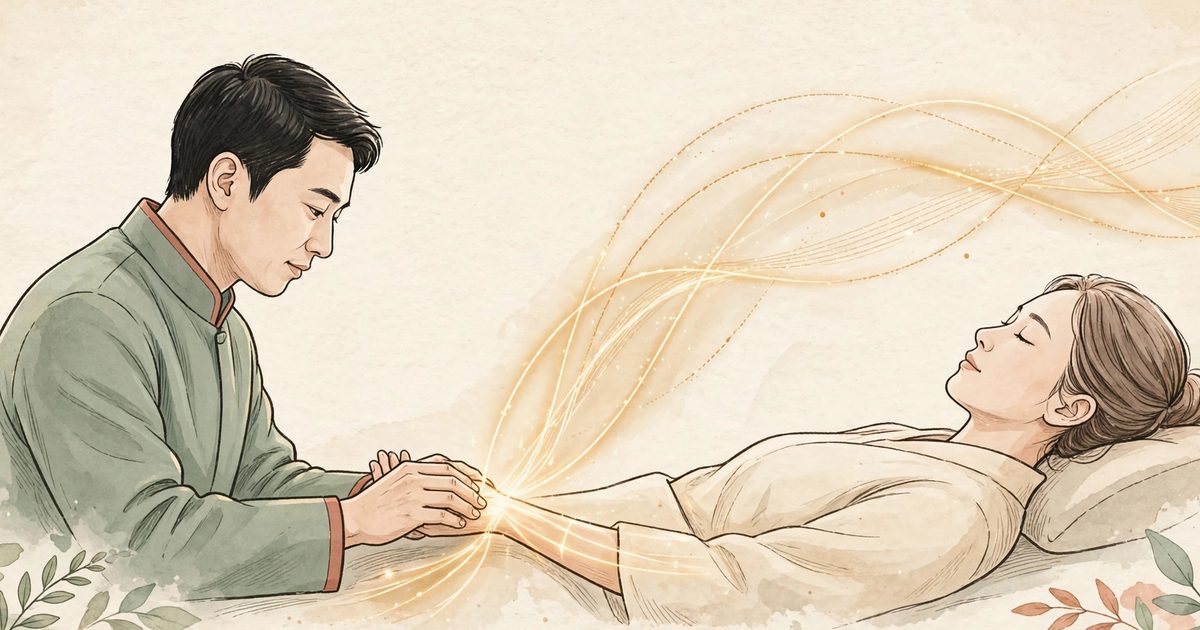
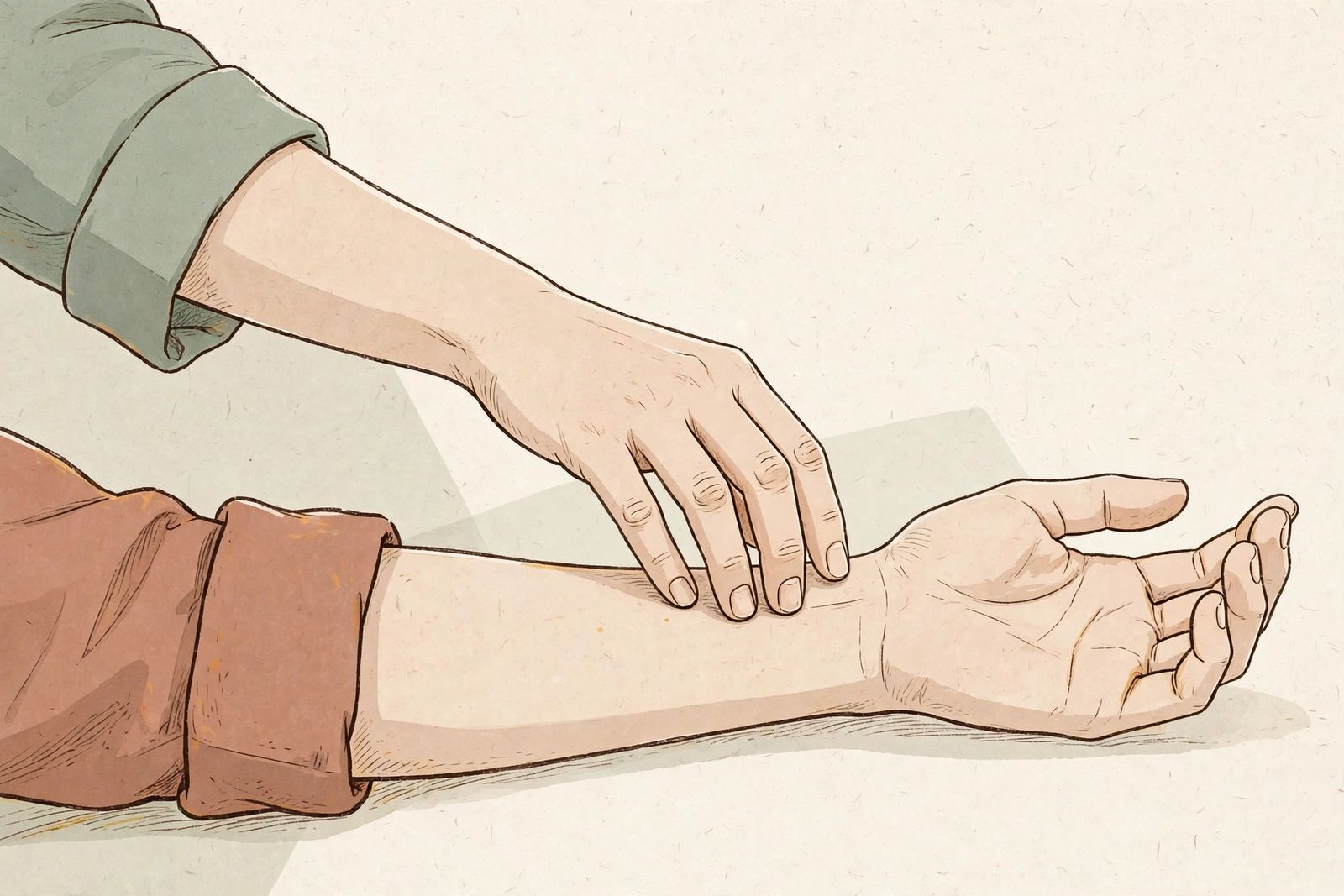
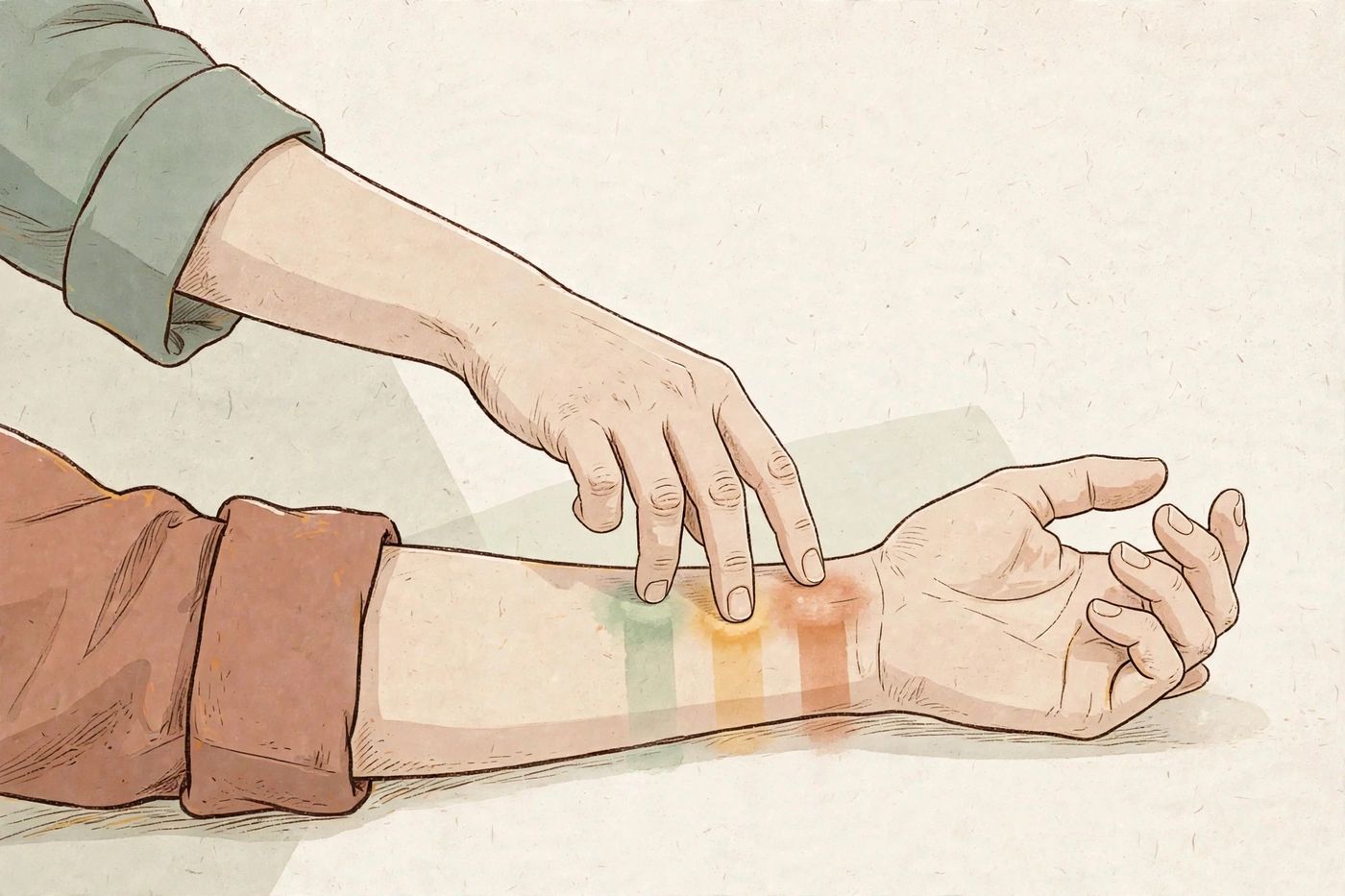
When you visit our clinic, one of the first things we do — before any needles, before any treatment plan — is take your pulse. Not the way a nurse does, counting beats against a clock for fifteen seconds. We rest three fingertips on your wrist and stay there, quietly, feeling not just how fast the pulse moves but how it moves: its depth, its width, its strength, its texture, the way it arrives and the way it leaves.
Patients often ask what we could possibly be feeling for in there. It is a fair question — and a good one, because the answer reaches back more than two thousand years. This article explains the theory behind pulse diagnosis: what the pulse actually is in East Asian medicine, how it connects to the body’s network of channels, and why a small patch of wrist can tell us so much about the whole of you.
What Is the Pulse? 脈 (maek)
In East Asian medicine, the pulse is far more than a heart rate. The character 脈 — read mai in Chinese and maek (맥) in Korean — originally referred to the vessels themselves: the pathways through which qi (기, the body’s vital activity) and blood circulate. The classical texts describe the vessels as containers of the blood and roadways for the movement of qi. The pulse you feel at the surface is the movement of that qi and blood, made tangible under the fingertips.
This matters because qi and blood are not confined to one place. They travel everywhere — nourishing every organ, every muscle, every joint. So when something is out of balance deep inside the body, the movement of qi and blood changes, and that change shows up in the pulse. A pulse can feel full or empty, smooth or rough, tense like a tightened string or soft like thread floating on water. Each quality carries information: about the organs, about whether qi and blood are plentiful or depleted, and about the balance between the body’s own defenses and whatever is troubling it.
Pulse diagnosis — 脈診, maekjin (맥진) — is one of the four classical examinations of East Asian medicine, alongside looking, listening, and asking, and it is widely considered the most nuanced of the four. Where the others gather what a patient can show or describe, the pulse must be read, and reading it well requires the longest training of any diagnostic skill. Its foundations were laid in the Inner Classic (Huangdi Neijing), compiled over two thousand years ago, and it was systematized a few centuries later in the Pulse Classic (Mai Jing, around the 3rd century CE) — a work devoted entirely to the pulse, which organized its qualities into a coherent clinical system that practitioners still study today.
“A number tells you the heart is beating. The qualities of the pulse tell you how the whole body is doing.”
Dr. Joshua Pak, DACM, L.Ac.
The Channels: The Body’s Network 經絡
To understand the pulse, you first need the map it travels on. East Asian medicine pictures the body as threaded through by a network of pathways called channels or meridians — 經絡 (gyeongnak, 경락). The channels connect the interior of the body with its exterior: they link the internal organs to the limbs, the surface of the skin to the depths, the upper body to the lower. Through them, qi and blood circulate continuously, delivering nourishment and carrying information from one part of the body to every other.
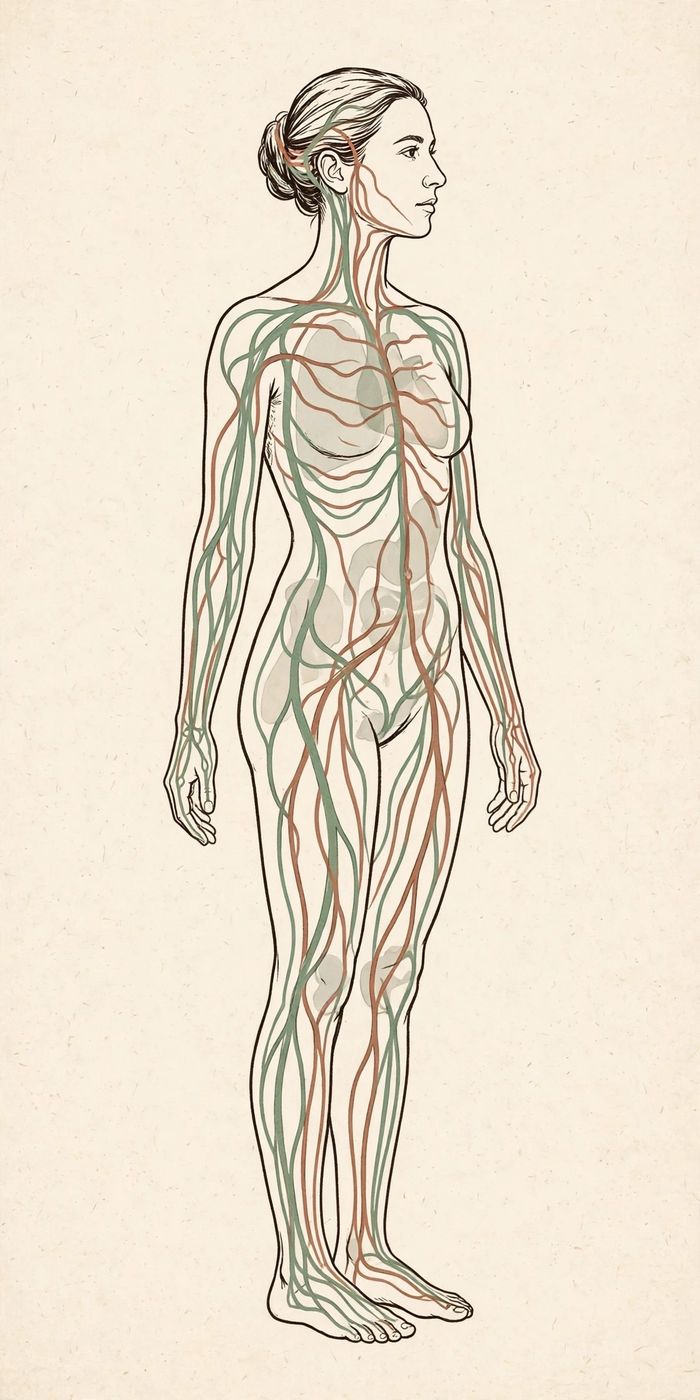
There are twelve regular channels, and each one is associated with an organ system — the Lung, the Heart, the Spleen, the Liver, the Kidney, and so on. (In East Asian medicine, an “organ” names a whole sphere of function, broader than the anatomical organ alone.) A helpful image is a river system: the organs are the reservoirs and springs, the channels are the rivers and tributaries, and qi and blood are the water. Another is a communications network, endlessly carrying supplies and signals between headquarters and the field.
Both images make the same point. When the flow through the channels is smooth and well distributed, the body is nourished and coordinated — that is health. When flow becomes blocked, depleted, or imbalanced somewhere along the network, the effects can surface as pain, dysfunction, or illness — sometimes at the site of the problem, sometimes far downstream from it. This is why a practitioner may treat a point on the leg for a problem in the abdomen: they are working on the same channel.
Where the Channels Meet the Fingertips
Here is the key link between the two ideas. The pulse is the place where the channels’ qi and blood become palpable — where the movement of the whole network rises close enough to the surface that trained fingers can feel it. Feeling the pulse is, quite literally, feeling the channels at work.
Why the wrist, though? Of all the places a pulse can be felt, practitioners settled on a spot on the inner wrist over the radial artery, a position called the cunkou (寸口, “inch-opening”). The reason is the channel that passes through it: the Lung channel of the hand runs directly through the cunkou. In East Asian medical theory, the Lung governs qi — it oversees the movement and distribution of qi throughout the entire body. So the pulse felt on the Lung’s own channel reflects, better than anywhere else, the overall state and movement of the body’s qi. One small window, opening onto the whole system.
It was not always done this way. In the earliest centuries of this tradition, practitioners palpated pulses at many sites along the channels — at the head, the hands, and the feet — comparing them against one another. Over the centuries, the wrist method was refined and eventually prevailed, because it proved to be both the most practical and, remarkably, the most informative: everything the multi-site method revealed could be read at the wrist, provided the reader knew how to divide it up.
Three positions, three depths
That division is the elegant part. The practitioner’s three fingertips rest in a row along the cunkou, and each fingertip reads a different position. From the wrist crease outward, they are the cun (寸, “inch”), the guan (關, “gate”), and the chi (尺, “foot”). The three positions correspond to the body’s three regions — upper, middle, and lower — and to the organ systems within them.
The three positions at the wrist
Each wrist is read the same way. The positions below are shown with the organ systems they are most commonly associated with.
Lung (right wrist)
Spleen (right wrist)
and the body’s root
Now do the arithmetic. Three positions on each of two wrists make six positions — and each one is felt at three depths, from a touch so light it barely dents the skin to a firm press nearly to the bone. Six positions at three depths gives the practitioner eighteen distinct points of information, arranged like a map of the body’s interior: upper and lower, left and right, surface and depth. A problem in the chest may speak most clearly at the cun position, near the surface; a deep, chronic depletion may only appear at the chi position, under heavy pressure. The map is small enough to fit under three fingertips — and detailed enough to occupy a practitioner’s whole training.
From Reading to Treatment
This is why pulse diagnosis sits at the center of our practice at JP Acupuncture & Wellness. The examination is not a ritual or a formality before the “real” treatment begins. It is how we decide what the treatment should be. Before any needle is placed, the pulse tells us where the imbalance lives — which channel, which region, at what depth — and whether the body needs something cleared and moved, or something depleted supported and rebuilt. Points are chosen, and re-chosen at each visit, according to what the pulse reports that day, because the body it describes is not the same body week to week.
At our clinic, this approach is called Pulse Regulating Acupuncture. We read the pulse before treatment, place the needles, and then check the pulse again to see how your body has responded — adjusting during the same visit when needed. It is a pulse-based, individualized way of working, rather than a fixed recipe for each condition. (Curious what happens in the body once the needles are in? Read What Happens in Your Body When the Needle Goes In?)
So the next time you are on the table and the room goes quiet while three fingers rest on your wrist, you will know what is happening. We are not counting. We are reading — following the movement of qi and blood through the channels, and listening for what the whole body has to say at the one place it speaks most clearly.
Experience It for Yourself
Curious what your own pulse might reveal? A pulse reading is part of every first visit at our Long Beach clinic. See what to expect at your first visit, or book now.
3816 Woodruff Ave, Suite 205, Long Beach, CA 90808 · Mon–Fri 9 AM–7 PM · Insurance may cover acupuncture