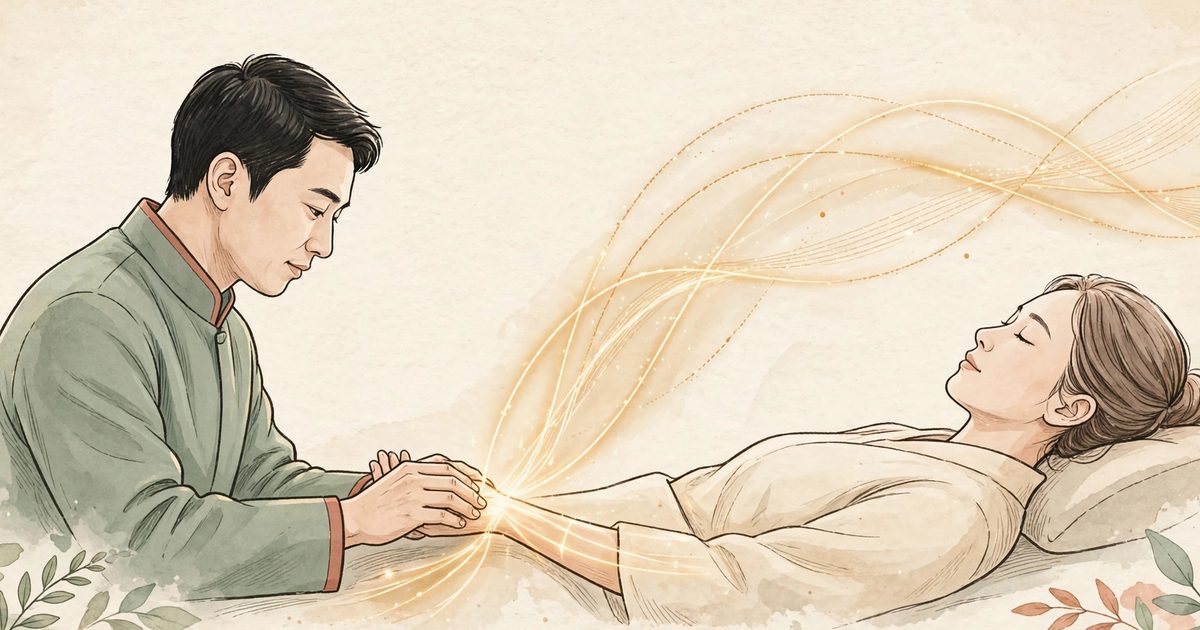
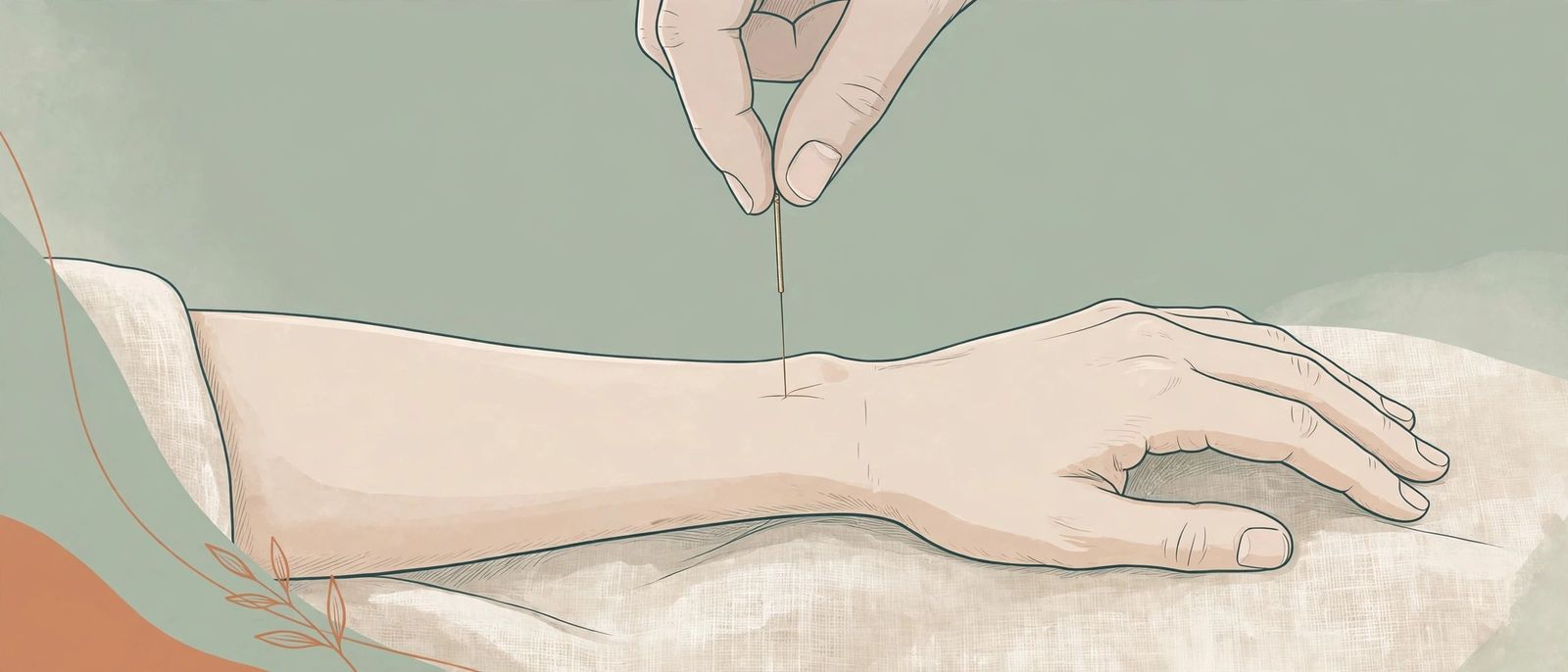
If you’ve had acupuncture, you may remember the moment a minute or so after the needles went in: a dull ache, heaviness, warmth, or faint tingling spreading from the point. Patients often ask, “Is that supposed to happen?” Yes — and it’s one of the most interesting parts of treatment, because that small sensation is the surface sign of measurable changes happening throughout the body.
For centuries, practitioners described these effects in the language of traditional theory: qi and meridians. Over the past fifty years, researchers at Harvard, the University of Rochester, the University of Vermont, and elsewhere have pointed their instruments at exactly that moment — brain scanners, EEG electrodes, microscopes. Here is what they found, in plain language.
The sensation itselfDeqi: “The Arrival of Qi”
That sensation has a name: deqi (得氣, “the arrival of qi”). When a needle is placed well at an acupuncture point and gently worked, patients typically feel dull aching, heaviness, numbness, warmth, or tingling around the point — quite different from the brief prick of the needle breaking the skin. Classical texts treat deqi as the sign the treatment has actually engaged: the qi has arrived, and the body’s response has begun.
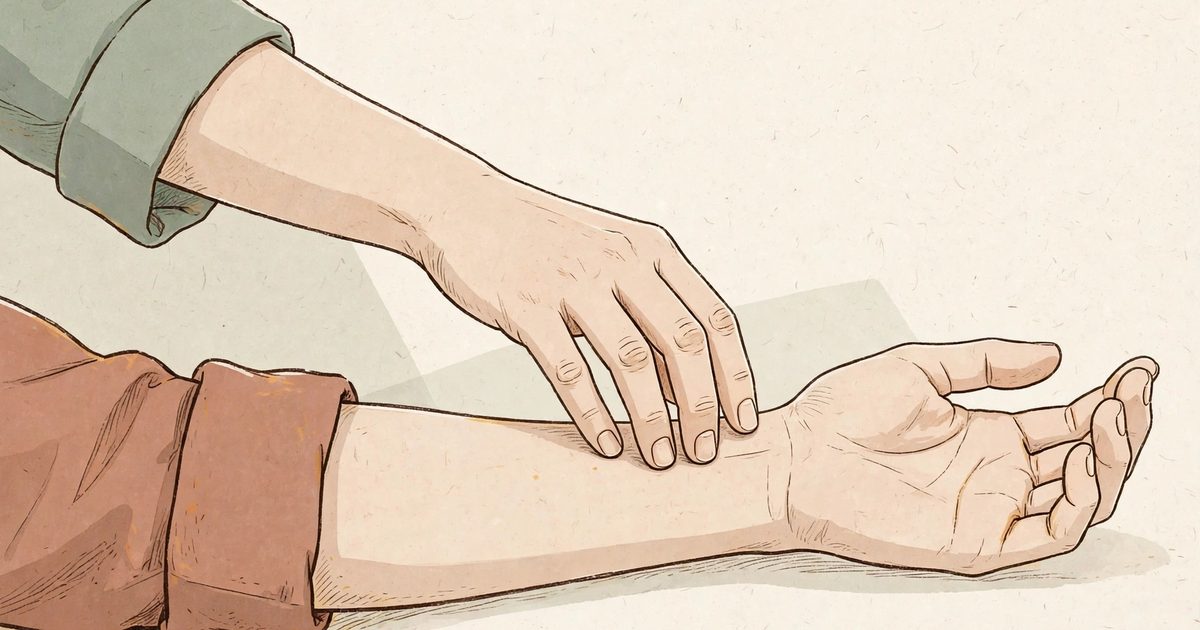
The practitioner feels it too — a subtle gripping at the needle called “needle grasp,” traditionally compared to a fish gently biting a fishing line. For years, Western science dismissed deqi as purely subjective. Then a generation of researchers decided to take it seriously as a clue and design experiments around it — and deqi became the thread connecting nearly every study in this article.
Deqi — the dull, heavy ache at the point — is the signal that the treatment has switched on.
Watching the brainYour Brain on Acupuncture: What fMRI Shows
Functional MRI lets researchers watch which parts of the brain become more or less active, moment by moment. A team led by Dr. Kathleen Hui at Harvard Medical School and Massachusetts General Hospital scanned volunteers receiving acupuncture at ST36 (Zusanli), a well-known point below the knee — while carefully recording exactly what each volunteer felt.
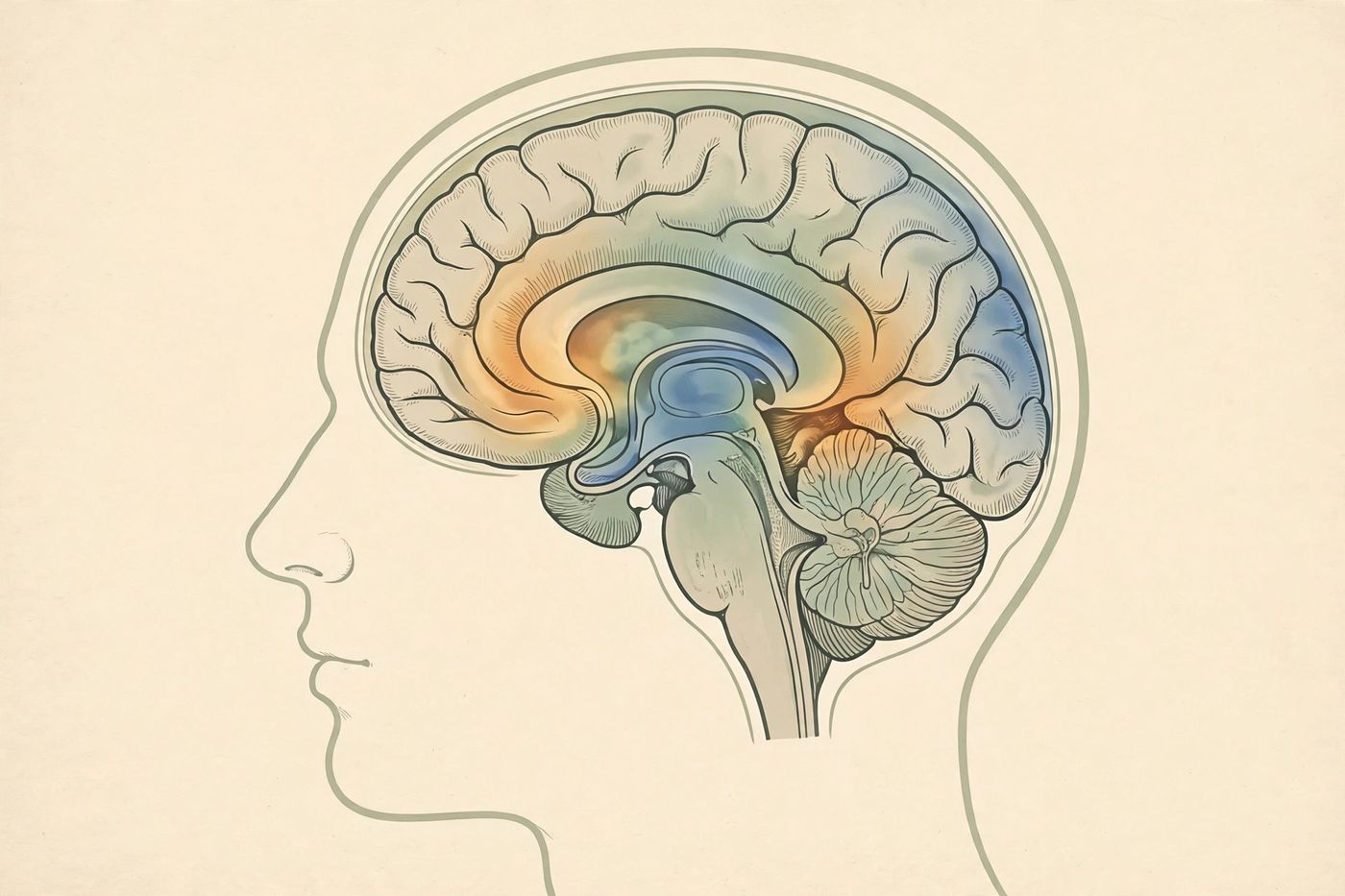
When volunteers experienced deqi without sharp pain, a broad network of deep brain regions — the limbic system, including the amygdala (the brain’s threat alarm) and the hypothalamus (a stress control center) — deactivated. The brain quieted the very circuits that amplify pain and distress. But when sharp pain crept in, the effect flipped and those regions lit up instead. Related work by Dr. Vitaly Napadow showed the response is also graded: stronger, still-comfortable stimulation produced a stronger response — a dose effect, much like a medication.
Gentle deqi calms the brain’s pain-and-emotion network on fMRI; sharp pain does the opposite — which is why technique matters.
Rhythm and restBrain Waves Change, Too: The EEG Evidence
Where fMRI maps where activity happens, EEG — electrodes on the scalp — shows how the brain’s overall state shifts. Across EEG studies, acupuncture increases activity in the alpha band (roughly 8–13 cycles per second): the rhythm of a mind that is awake but relaxed, the state you drift toward in meditation or just before sleep. Studies also report shifts in frontal alpha balance, a marker studied in relation to mood and stress.
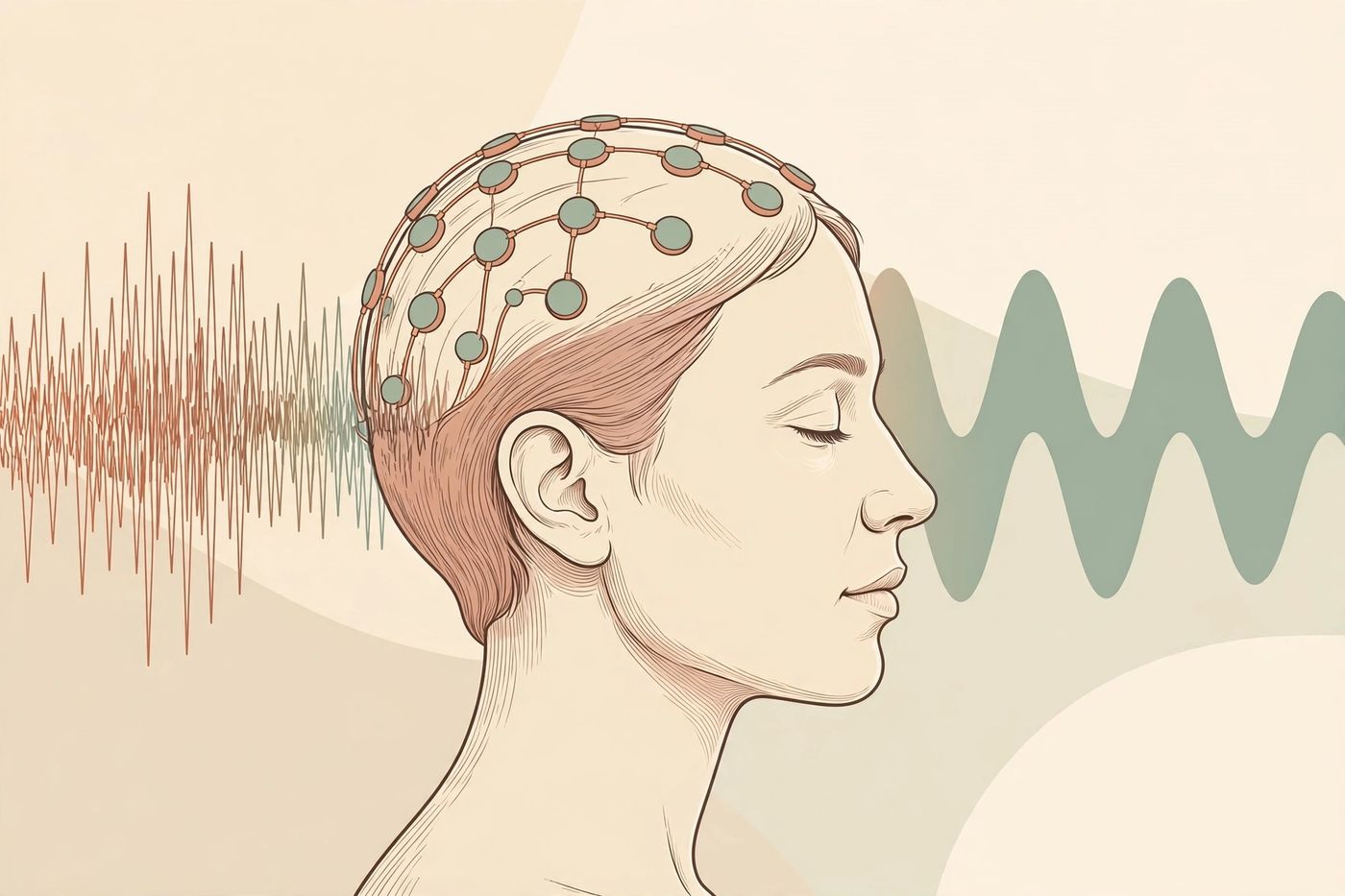
One study shows this neatly: sleep deprivation scrambles normal brain-wave patterns, and researchers found that acupuncture at GV20 (Baihui), the point at the very top of the head, helped nudge those disrupted frequencies back toward their resting pattern. It was a small study — but it captures the theme of the EEG research: acupuncture tends to move brain activity toward a calmer, more organized state.
On EEG, acupuncture shifts brain waves toward the relaxed alpha pattern — the rhythm of calm alertness.
The chemistry of reliefYour Body’s Own Painkillers: Endorphins
The brain findings raise a chemical question: how does a needle in the leg quiet pain circuits in the brain? The first big answer came in 1976, from neuroscientist Bruce Pomeranz in Toronto. His test was elegant: naloxone is a drug that blocks opioid receptors — the same receptors morphine acts on. If acupuncture’s pain relief depended on the body’s own opioids, naloxone should cancel it.
It did. When subjects received naloxone, acupuncture’s pain relief was reversed — block the receptors, and the relief goes away. It remains one of the clearest demonstrations that needling works, in part, by prompting the body to release its own pain-relieving chemicals: endorphins, enkephalins, and dynorphins. The needle contains no medicine — it prompts the body to dispense its own.
A drug that blocks opioid receptors switches off acupuncture’s relief — strong evidence the body releases its own natural painkillers.
Local actionAdenosine: The Painkiller Released Right at the Needle
Endorphins explain effects that travel through the brain and spinal cord — but some of acupuncture’s pain relief is local, right around the needle. In 2010, a University of Rochester team led by Dr. Maiken Nedergaard and Dr. Nanna Goldman (Nature Neuroscience) found that gentle needle rotation causes a surge of adenosine in the tissue — a compound better known for building sleep pressure (it’s what caffeine blocks). Adenosine docks onto A1 receptors on pain-transmitting nerve fibers and quiets them, right where the needle is.
The proof was unusually direct: mice genetically lacking the A1 receptor got no pain relief from needling, and merely inserting the needle wasn’t enough — the effect required needle manipulation, the gentle rotation practitioners use to elicit deqi. The classical instruction and the modern chemistry converge on the exact same step.
Rotating the needle releases adenosine right at the point — a local painkiller the tissue makes itself.
Under the microscopeThe Tissue Itself Responds: Connective Tissue and “Needle Grasp”
One mystery remained: what is needle grasp, physically? The answer came from Dr. Helene Langevin, then at the University of Vermont. Her team discovered that when a needle is rotated, the connective tissue beneath the skin — the web of collagen that wraps muscles and holds the body together — literally winds around the needle shaft, like spaghetti around a fork. That winding is the tug both patient and practitioner feel.
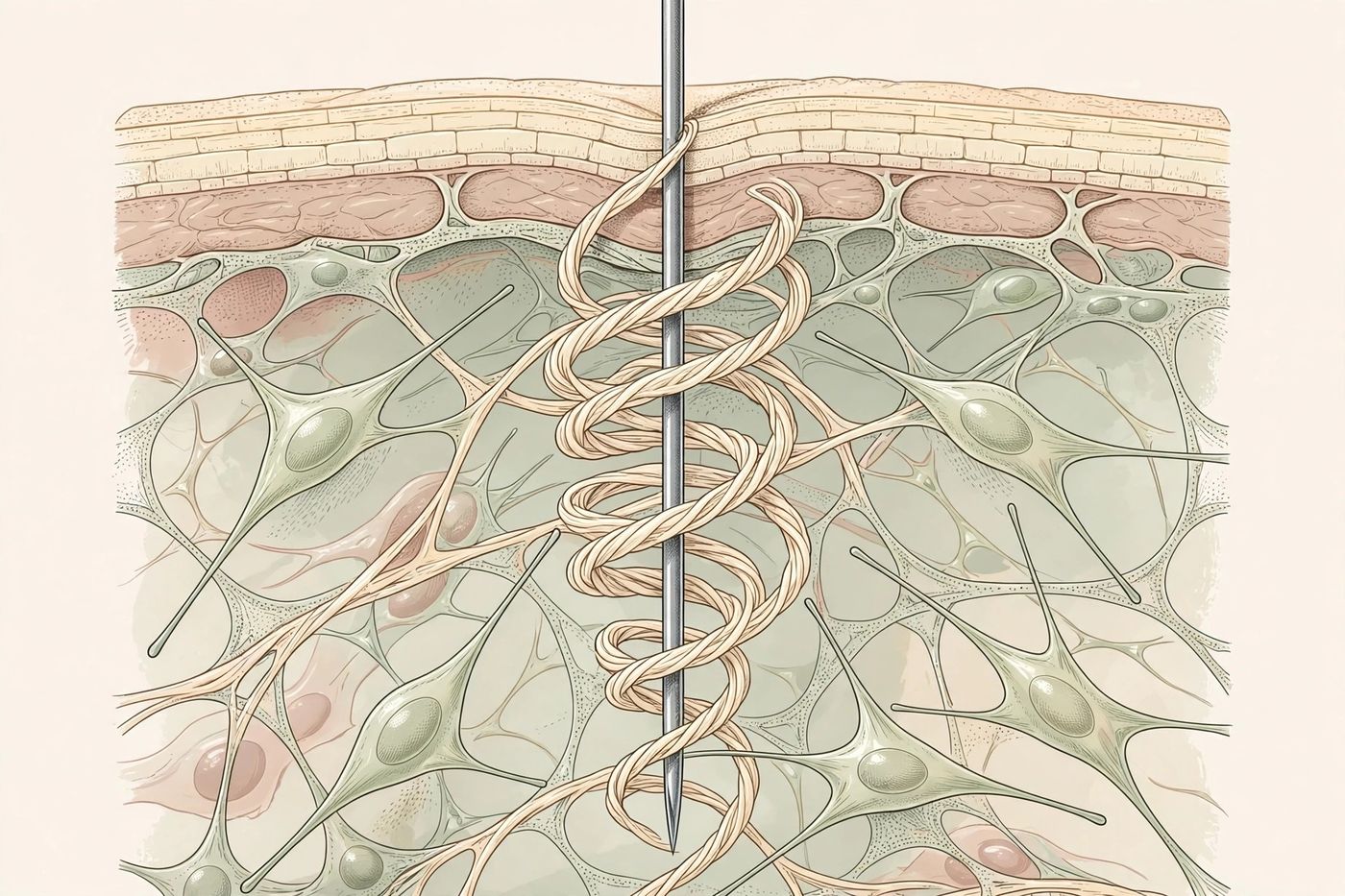
The winding does more than create a sensation. As the collagen wraps, it pulls on fibroblasts — the cells that maintain connective tissue — which stretch, change shape, and switch on signaling that can travel through the tissue well beyond the needle itself. Langevin’s team also found the pull-out force is greater at true acupuncture points than at nearby non-points, and that roughly 80% of acupuncture points correspond to connective-tissue planes — the seams where this winding happens most readily.
Needle grasp is real and mechanical: collagen winds around the needle and carries signals deep into the tissue.
Bringing it togetherWhat This Means for Your Treatment
Step back, and a coherent picture emerges. When deqi arrives, several things happen at once: the tissue winds around the needle and releases adenosine that quiets local pain fibers; sensory nerves carry a calming — not alarming — signal to the spinal cord and brain; the brain and spinal cord release the body’s own opioids; and on scans, pain-and-emotion networks quiet down while brain waves shift toward the relaxed alpha pattern.
Deqi, in other words, isn’t imagination or suggestion — it’s the felt side of all of this happening. That’s why your acupuncturist asks what you’re feeling and adjusts the needles in response: a dull, heavy ache (rather than sharp pain) is real-time information that the treatment is engaging these responses. At our clinic, treatment is guided by Pulse Regulating Acupuncture, our pulse-based, individualized approach, and the aim at every visit is that dull, heavy calm of deqi — never sharp pain.
If you’re new to acupuncture, see what to expect at your first visit — you can also complete your intake form online before you arrive. Many patients are surprised to learn their insurance may cover acupuncture.
Deqi is your body’s response switching on — tissue, nerves, chemistry, and brain, all at once.
Experience It for Yourself
Curious what deqi feels like — and how acupuncture may help with your pain, stress, or sleep? Book a visit with Dr. Pak at JP Acupuncture & Wellness in Long Beach.
3816 Woodruff Ave, Suite 205, Long Beach, CA 90808 · Mon–Fri 9 AM–7 PM