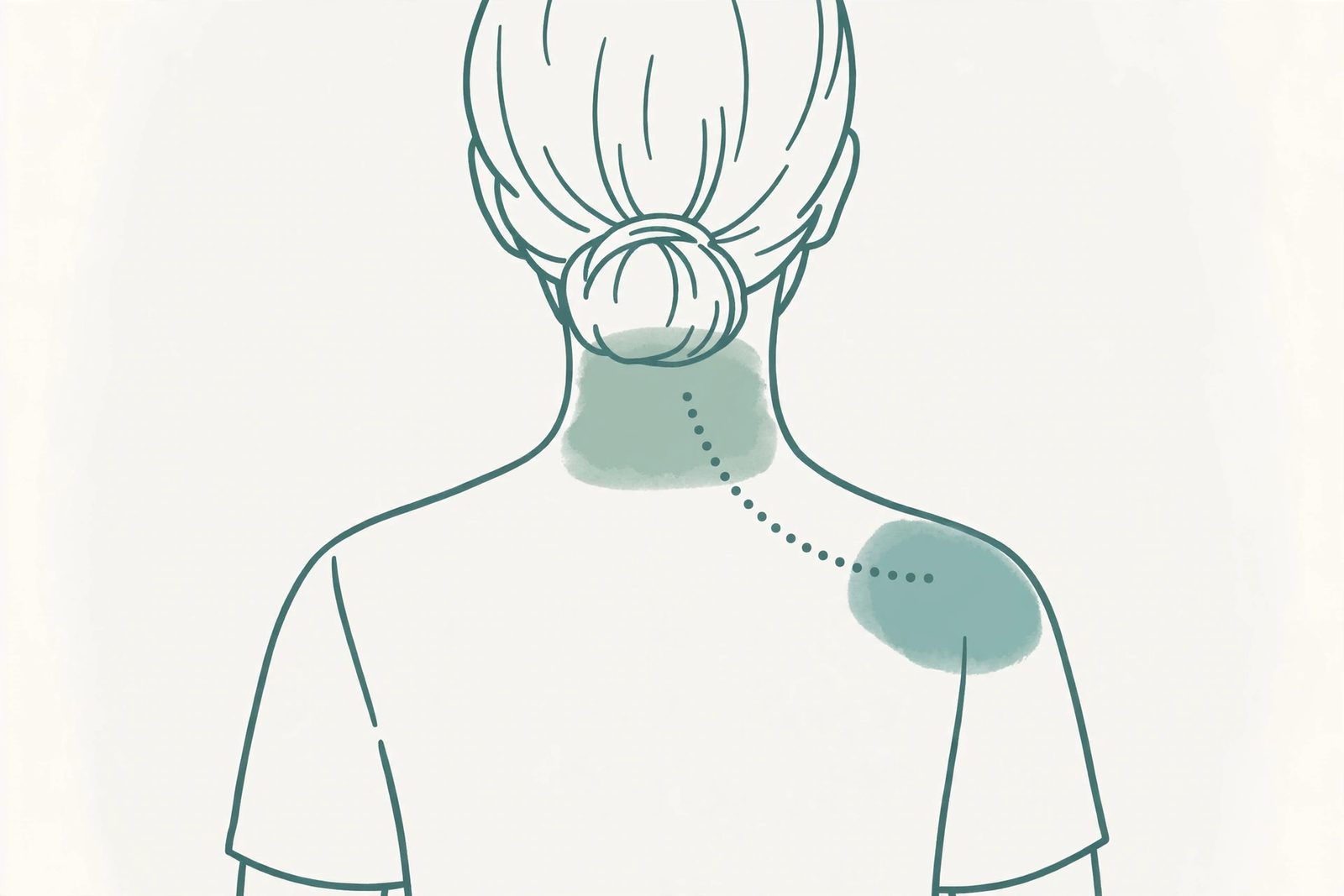
You point to your shoulder and say, “It hurts here.” Fair enough. But the spot that hurts is not always the spot that is causing the problem. The neck and the shoulder share nerves, muscles, and movement, so trouble in one often shows up as pain in the other.
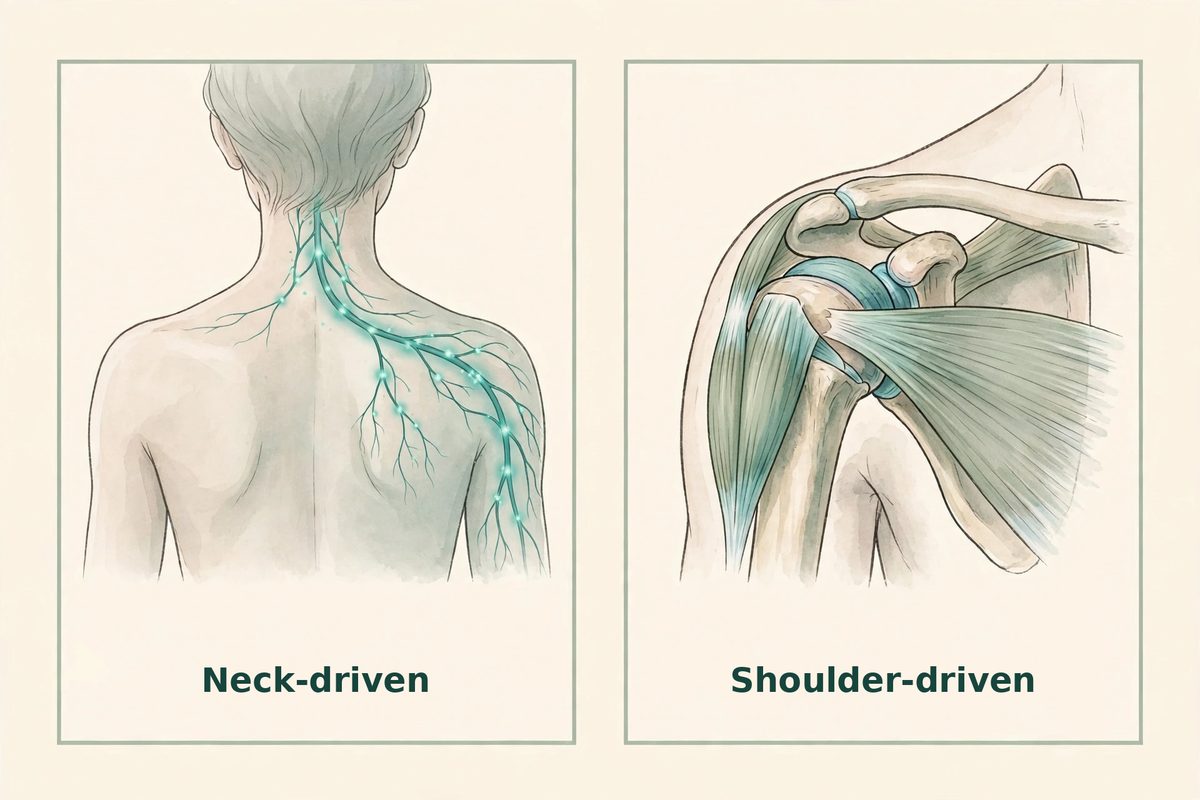
That matters, because neck-driven pain and shoulder-driven pain need different care. Stretching a shoulder that is really a neck problem rarely helps for long. Three simple clues help you sort it out at home.
- Clue 1: If turning or tilting your neck changes the shoulder pain, the neck is likely involved.
- Clue 2: If lifting your arm hurts partway up, the shoulder itself is more likely the source.
- Clue 3: Pain or tingling that runs past the elbow into the hand points toward a nerve in the neck.
- Both can be involved at once. A hands-on exam sorts out what a self-check cannot.
- An arm you cannot lift after a fall, or weakness that keeps getting worse, needs medical care first.
01Why the neck can make your shoulder hurt
The nerves that serve your shoulder and arm leave the spine in your neck. When a joint, disc, or tight muscle in the neck irritates one of those nerves, your brain can feel the pain farther down the line — over the shoulder blade, across the top of the shoulder, or down the upper arm. This is called referred pain. It is why some people with a neck problem feel almost nothing in the neck itself.
The reverse happens too. A stiff, painful shoulder changes how you hold your arm, and the neck and upper back muscles work overtime to make up for it. After a few weeks, both areas ache.
02Clue 1: Does moving your neck change the shoulder pain?
Sit tall. Slowly turn your head toward the sore side, then look up a little. Next, gently tilt your ear toward that shoulder. Move slowly, and stop right away if a movement causes sharp pain or sends tingling down your arm — that alone is your answer.
If any of these neck movements brings on your shoulder pain, or clearly changes it, the neck is likely part of the picture. If your neck moves freely and the shoulder feels the same no matter what your head does, the shoulder itself is the more likely source.
What tends to help a neck-driven pattern: screen at eye level, a pillow that keeps your neck in line with your spine, short movement breaks every 30 to 45 minutes, gentle chin tucks, and warmth on the neck and upper back. If you also get headaches at the back of the head, see our guide Where Does Your Headache Start?
03Clue 2: Does lifting your arm hurt partway up?
Stand and slowly raise the sore arm out to the side, thumb pointing up. Many shoulder problems hurt most partway up — from about halfway to just above shoulder height — and then ease as the arm goes higher. Clinicians call this a painful arc. It often points to the rotator cuff tendons or the space just above the joint.
Try one more check. Let a family member slowly lift your relaxed arm for you.
- You cannot lift it, but they can: the muscles that lift the arm may be weak or irritated, often the rotator cuff.
- Neither of you can lift it, in any direction: the joint itself may be stiff. That is the frozen shoulder pattern (see below).
- It lifts fine both ways and only the neck test bothered you: the neck is the more likely source.
What tends to help a shoulder-driven pattern: less overhead reaching for a while, carrying loads close to your body, sleeping on the other side with a pillow hugged to your chest, and gentle pendulum swings — lean on a table with your good arm and let the sore arm hang and draw small circles.
04Clue 3: Does it travel down into your hand?
Pain, tingling, or numbness that runs in a line past the elbow into the forearm or fingers behaves differently from a shoulder ache. That traveling pattern usually means a nerve root in the neck is irritated. It may flare when you look up, cough, or sit with your head forward for a long time, and it can come with a weaker grip.
Which fingers tingle is a clue of its own. Our guide Which Fingers Are Numb? explains how to read that map.
05At a glance
| More like the neck | More like the shoulder | |
|---|---|---|
| Neck movement | Turning or tilting the neck changes the pain | Neck movement makes little difference |
| Lifting the arm | Lifts fairly freely | Hurts partway up; overhead reach is hard |
| Where it goes | May run past the elbow into the hand | Stays around the shoulder and upper arm |
| Worse with | Long sitting, looking down at a phone, high pillow | Reaching overhead or behind the back, lying on that side |
This is a guide, not a diagnosis. The neck and shoulder often irritate each other, so both may need care at the same time.
06What about frozen shoulder?
Frozen shoulder (adhesive capsulitis) has its own pattern: the shoulder grows stiff in every direction, and no one can lift the arm fully — not you and not a helper. It is most common between about 40 and 60, and more common in people with diabetes or thyroid conditions. In Korea and Japan it is even nicknamed the “fifty-year shoulder.”
Frozen shoulder is one of the conditions we specialize in, and we will cover it in depth in an upcoming article.
07When to get medical care first
If shoulder pain comes with chest pressure, shortness of breath, sweating, or pain spreading to the jaw. These can be signs of a heart problem.
- An arm you cannot lift after a fall, injury, or dislocation
- Arm or hand weakness that is getting worse over days
- Fever with shoulder pain, or a hot, swollen joint
- Numbness or weakness in both arms, or new trouble with balance or walking
- Night pain that keeps waking you, week after week, without improving
Don’t stretch or treat these at home. Get checked first.
08How Eastern Medicine Can Help
Eastern medicine maps the shoulder along channels — pathways of qi and blood. The front of the shoulder, the outer side, the back of the shoulder blade, and the top of the shoulder running up into the neck each sit on a different channel. Where your pain sits, and which movements set it off, tells us which pathways are blocked. It mirrors the three clues above, read in a different language.
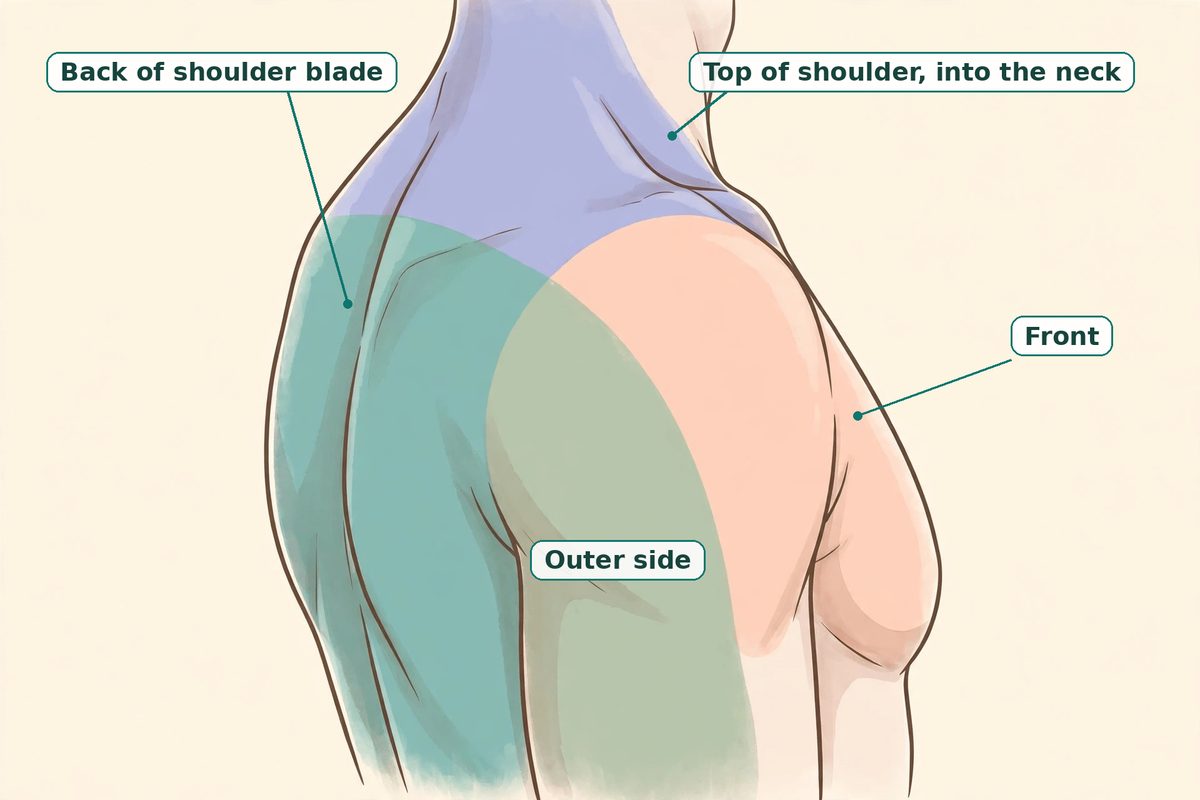
At JP Acupuncture, care starts with a hands-on assessment — where it hurts, how you move, your posture, and your overall health. From there, we choose the tools that fit: acupuncture, electro-acupuncture, cupping, tui na (hands-on bodywork), and a step-by-step home exercise plan. When it fits your case, we also use Pulse Regulating Acupuncture (PRA), our signature approach: we read the pulse, place needles, re-check how the pulse responds, and adjust in the same visit. Because neck-driven and shoulder-driven pain need different care, treatment is adjusted visit by visit — not a fixed set of points used for everyone.
Acupuncture works alongside — not instead of — care from your physician. Research suggests it may help reduce shoulder and neck pain and improve function for some people, though results vary from person to person.
The bottom line
Three questions do most of the sorting. Does moving your neck change it? Does lifting your arm hurt partway up? Does it run down into your hand? Your answers point to the neck, the shoulder, or both — and they help us decide where to start. If any warning sign shows up, get medical care first.
Shoulder or neck — not sure which?
Book a visit at our Long Beach clinic. We’ll check your neck and shoulder, show you what we find, and give you an honest plan. Injured at work or in a car accident? We also work with workers’ comp and auto injury claims.
New here? Start with your first visit and our online intake form. Most insurance plans accepted — how insurance works here.
3816 Woodruff Ave, Suite 205, Long Beach, CA 90808 · Mon–Fri 9 AM–7 PM