When fingers tingle or go numb, most people say the same thing: “My hand keeps falling asleep.” But which fingers are involved matters a lot.
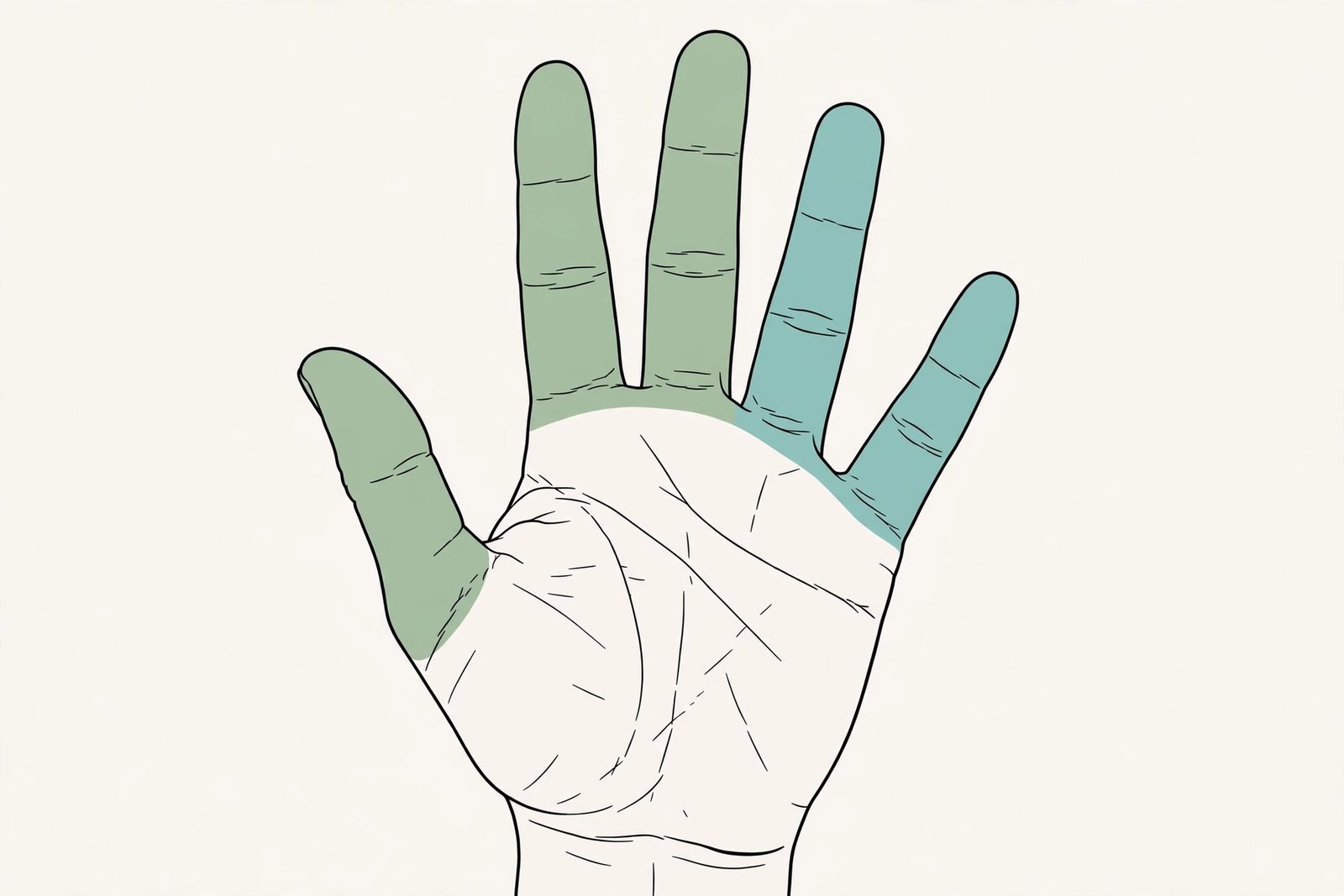
Nerves travel from your neck, past your elbow, through your wrist, and into specific fingers — like labeled wires. So the pattern of numbness works like a map. Read which fingers are numb, and you have a strong clue about where along the path a nerve is being squeezed.
- Thumb, index, middle (and half the ring finger): the median nerve — most often pinched at the wrist (carpal tunnel).
- Pinky and the other half of the ring finger: the ulnar nerve — most often irritated at the elbow.
- Symptoms that climb above the wrist, or change when you move your neck: think about a nerve root in the neck.
- Both hands, or hands and feet together: ask your physician about whole-body causes such as blood sugar or vitamin B12.
- Wasting at the base of the thumb or a weakening grip needs prompt care. Sudden numbness with facial droop: call 911.
01Map 1: Thumb, index, and middle finger — the wrist
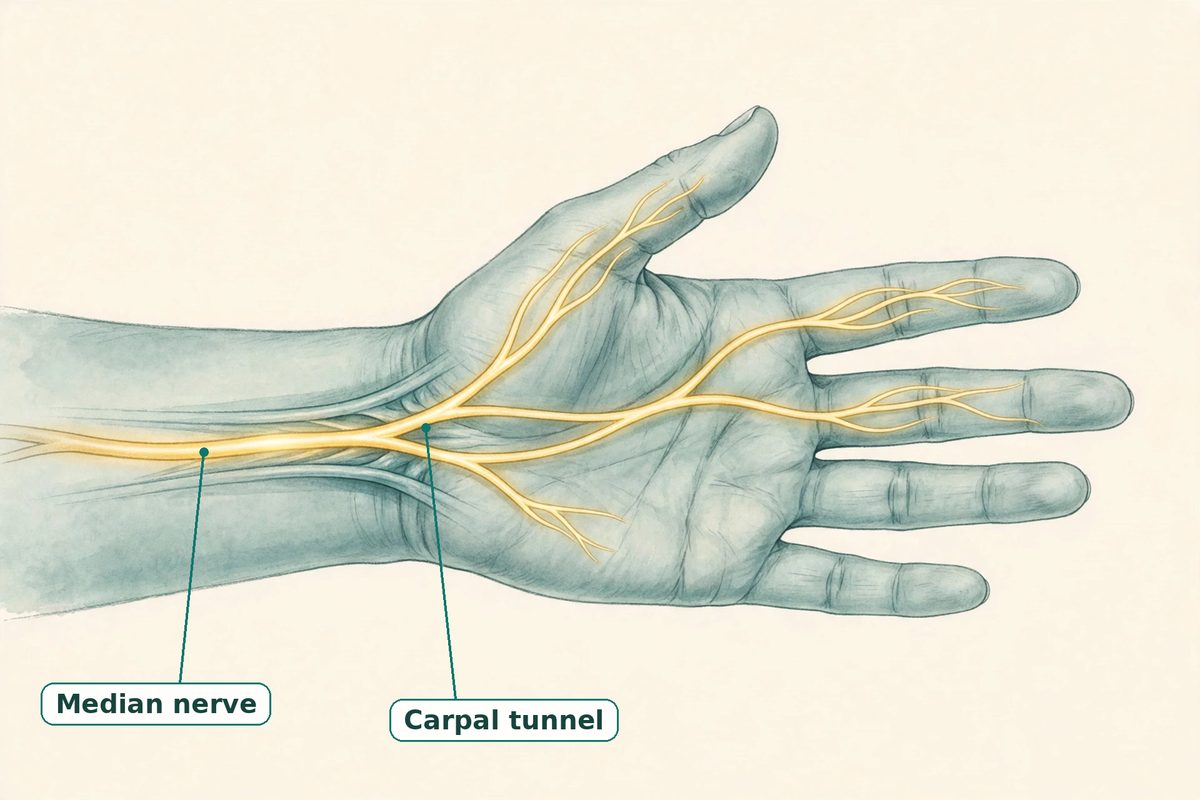
The median nerve passes through a narrow channel in the wrist called the carpal tunnel. From there it serves the thumb, index finger, middle finger, and the thumb-side half of the ring finger. When the tunnel gets crowded, numbness and tingling follow that exact territory. This is carpal tunnel syndrome.
Clues that fit this map:
- Worse at night, sometimes waking you up
- Shaking or flicking the hand brings relief
- Set off by driving, holding a phone, reading in bed, or long keyboard or tool work
- The palm itself is usually spared, because the nerve branch to the palm runs outside the tunnel
Pregnancy can also bring on this pattern for a while, from fluid shifts.
02Map 2: Pinky and ring finger — the elbow
The ulnar nerve runs behind the inner elbow — it is your “funny bone.” It serves the pinky and the pinky-side half of the ring finger. If your numbness lives there, the elbow is the most common place to look.
Clues that fit this map:
- Tingling when the elbow stays bent, such as holding a phone to your ear
- Leaning on your elbow at a desk or on the car door
- Sleeping with your arms tucked and elbows deeply bent
- Clumsiness with fine tasks, or a weaker pinch over time
03Map 3: When the map points to the neck
Sometimes the fingers tingle because a nerve root is irritated where it leaves the neck. Depending on which root is involved, the fingers can look like either map above — thumb and index, the middle finger, or the pinky side. So the fingers alone can fool you. Two other hints point upward:
- The symptoms don’t stay in the hand. They reach above the wrist into the forearm or upper arm, often with an ache in the neck or shoulder blade.
- Neck movement changes them. Looking up, turning your head, or sitting with your head forward brings them on.
A nerve can also be squeezed in two places at once — at the neck and the wrist, for example. That is why “which fingers” is the first question, not the only one. If your shoulder aches too, our guide Is It Your Shoulder or Your Neck? can help you sort it out.
04Quick finger map
| Fingers involved | Nerve | Most common pinch point | Typical clues |
|---|---|---|---|
| Thumb, index, middle, half of ring | Median | Wrist (carpal tunnel) | Worse at night; shaking helps; palm usually spared |
| Pinky, half of ring | Ulnar | Elbow | Worse with the elbow bent or leaned on |
| Can mimic either | Neck nerve root | Neck | Reaches the forearm or upper arm; changes with neck movement |
| Both hands, or hands and feet | Many small nerves | Whole body | Gradual, often in a “glove” pattern — ask about blood sugar, B12, thyroid |
This is a guide, not a diagnosis. An exam — and sometimes nerve testing ordered by your physician — confirms where the problem sits.
05What you can do at home
- Wrist map: a wrist splint worn at night, holding the wrist straight, often eases night symptoms. During the day, keep wrists straight rather than bent, and take short breaks from gripping and typing.
- Elbow map: stop leaning on the elbow, pad hard armrests, and use earbuds or speaker mode instead of holding the phone to your ear. At night, a towel wrapped loosely around the elbow keeps it from bending fully.
- Neck map: screen at eye level, fewer hours looking down at the phone, and a pillow that keeps the neck level.
- Any map: gentle nerve-gliding moves — slow, easy motions that slide the nerve rather than stretch it hard. Stop if numbness sharply increases.
- Check the basics: mention ongoing numbness to your physician. Diabetes, thyroid problems, and low vitamin B12 can all affect nerves, and simple blood work checks them.
06When to get medical care
For sudden numbness or weakness in the arm, face, or leg — especially on one side — or facial droop or trouble speaking. These can be signs of a stroke.
- Visible thinning of the muscle at the base of the thumb
- Dropping things often, or a grip that keeps getting weaker
- Numbness that is constant rather than coming and going
- Numbness in both hands along with clumsiness, balance trouble, or leg symptoms
Don’t stretch or treat these at home. Get checked first.
07How Eastern Medicine Can Help
Here is something many people don’t know: Eastern medicine has its own finger map. Each finger sits at the end of a channel — a pathway of qi and blood. The thumb connects with the Lung channel, the index finger with the Large Intestine, the middle finger with the Pericardium, the ring finger with the Triple Burner, and the pinky with the Heart and Small Intestine channels. Which fingers go numb helps show which pathways are not flowing well — a second map laid over the nerve map.
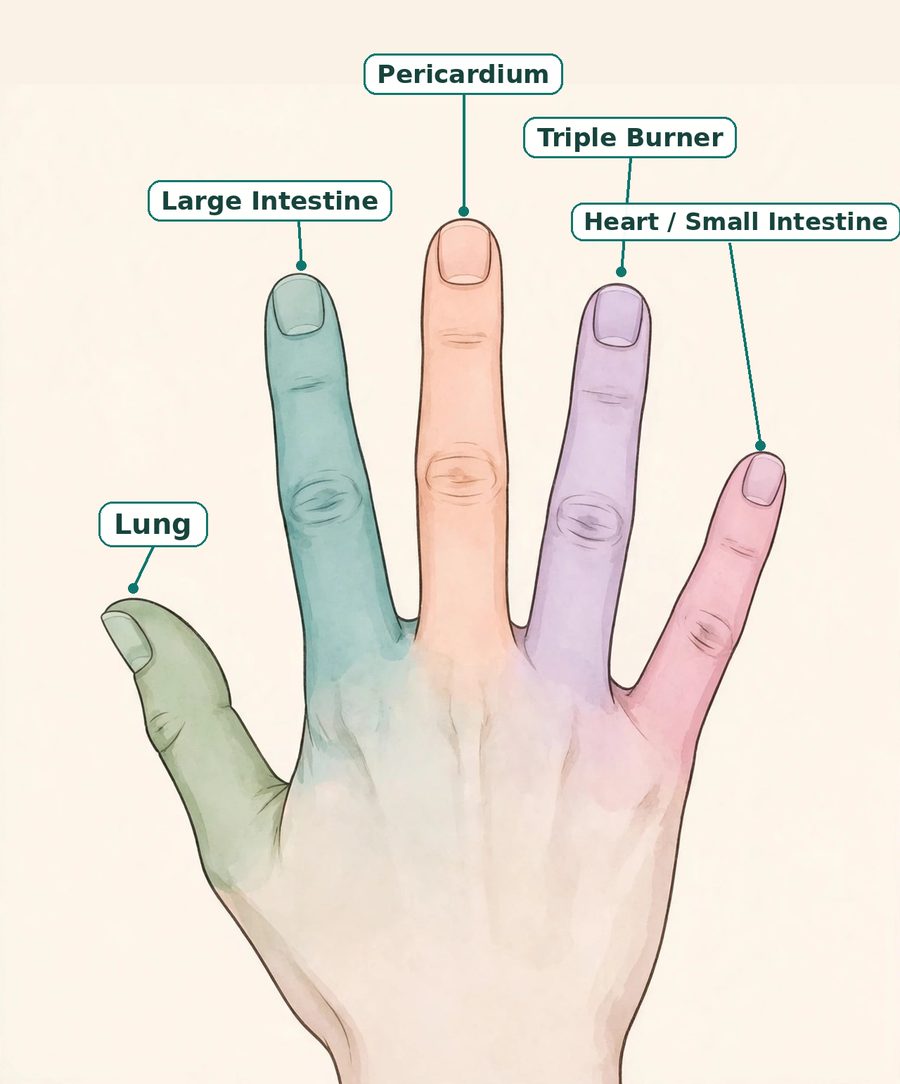
At JP Acupuncture, care starts with a hands-on assessment — which fingers, when it happens, how your neck, shoulder, elbow, and wrist move, and your overall health. From there, we choose the tools that fit your map: acupuncture, electro-acupuncture when it fits, releasing tight muscles in the neck, chest, and forearm that can crowd the nerve’s path, and wrist and nerve-gliding exercises you can keep doing at home. When it fits your case, we also use Pulse Regulating Acupuncture (PRA), our signature approach: we read the pulse, place needles, re-check how the pulse responds, and adjust in the same visit.
Acupuncture works alongside — not instead of — care from your physician. Research suggests it may help some people with hand numbness and carpal tunnel symptoms, though results vary from person to person. If testing or medical treatment is needed, we will tell you and work with your physician.
The bottom line
The next time your hand goes numb, look at the map before it fades. Thumb-side fingers point to the wrist. Pinky-side fingers point to the elbow. Symptoms that climb above the wrist or change with neck movement point to the neck. Both hands at once points to a whole-body check. That one look makes your first visit far more useful — and helps you catch warning signs early.
Fingers going numb — not sure why?
Book a visit at our Long Beach clinic. We’ll check your neck, elbow, and wrist and give you an honest plan. Injured at work or in a car accident? We also work with workers’ comp and auto injury claims.
New here? Start with your first visit and our online intake form. Most insurance plans accepted — how insurance works here.
3816 Woodruff Ave, Suite 205, Long Beach, CA 90808 · Mon–Fri 9 AM–7 PM